
Mastering Graphic Design Portfolio Tips for Success
graphic design portfolio tips

Mastering Graphic Design Portfolio Tips for Success

Elevate your design career by crafting an irresistible portfolio that captures attention and lands your dream opportunities.

Start Building Your Dream Portfolio

Key Takeaways

  • ✓ Your portfolio is your most powerful marketing tool.
  • ✓ Quality over quantity is crucial for impact.
  • ✓ Tailoring your portfolio to each opportunity is essential.
  • ✓ Storytelling through projects makes your work memorable.

How It Works

1
Define Your Niche & Goals

Before selecting projects, clarify your target roles and industries. This focus guides content selection and presentation for maximum relevance.

2
Curate Your Best Work

Select only your strongest, most relevant projects that showcase your skills and problem-solving abilities. Focus on quality over quantity to make a powerful impression.

3
Craft Compelling Case Studies

Each project needs a story: outline the problem, your process, and the solution/impact. This demonstrates your thinking and value beyond just aesthetics.

4
Choose the Right Platform

Select a platform that best presents your work – a personal website offers maximum control, while platforms like Behance provide community exposure. Ensure it's responsive and user-friendly.

The Foundation: Understanding Your Audience and Purpose

Professional woman in a blazer discusses finance graphs on a whiteboard during a presentation. Photo: Mikhail Nilov / Pexels
Before you even consider which projects to include, the most fundamental of graphic design portfolio tips involves a deep dive into understanding your audience and the specific purpose of your portfolio. This isn't just a collection of pretty pictures; it's a strategic marketing tool designed to achieve a very specific outcome: getting you hired, winning a client, or securing an educational opportunity. Without a clear understanding of who you're trying to impress and what they're looking for, your portfolio risks becoming a generalist's scrapbook rather than a specialist's showcase. Start by asking yourself: Who is my ideal viewer? Are they a creative director at a bustling advertising agency, a small business owner looking for a branding expert, or an admissions committee for a prestigious design program? Each of these audiences has different priorities, expectations, and even different ways of evaluating design work. A creative director might be looking for innovative conceptual thinking and a strong grasp of design principles, while a small business owner might prioritize clear communication, reliability, and a portfolio that demonstrates practical, results-driven design. An admissions committee, on the other hand, might be seeking potential, a unique voice, and a willingness to experiment. Once you’ve identified your primary audience, define your portfolio’s purpose. Is it to land a full-time job in UI/UX design? To attract freelance clients for logo and brand identity work? Or to demonstrate your mastery of motion graphics? Your purpose will dictate the types of projects you feature, the depth of your case studies, and even the overall tone and aesthetic of your portfolio. For instance, if you're aiming for a UI/UX role, your portfolio should heavily feature process, user flows, wireframes, and prototypes, demonstrating your problem-solving methodology. If you're targeting brand identity, you'll want to highlight comprehensive branding projects, showing consistency across various touchpoints and a strong understanding of brand strategy. The more specific you are about your audience and purpose, the more effectively you can tailor your content, making every piece of your portfolio a deliberate choice rather than a random inclusion. This foundational step is often overlooked but is absolutely critical for creating a truly impactful and successful portfolio. Remember, your portfolio isn't just about showing what you can do; it's about showing what you can do for *them*. A well-defined purpose ensures every element serves this ultimate goal, transforming your portfolio from a mere collection into a compelling narrative of your abilities and potential. For more insights on strategic career moves, consider exploring resources on building a design career. This initial strategic thinking will save you countless hours later and significantly increase your chances of success.

Curating Your Masterpieces: Quality Over Quantity

A woman arranges abstract paintings on an indoor gallery wall, focusing on creativity. Photo: Greta Hoffman / Pexels
One of the most crucial graphic design portfolio tips, often repeated but frequently underestimated, is the principle of quality over quantity. It's a common misconception, especially for emerging designers, that a larger portfolio equals more opportunities. In reality, a leaner, highly curated selection of your absolute best work will always outperform a sprawling collection of mediocre or even just 'good' projects. Recruiters and potential clients are incredibly busy; they don't have the time or inclination to sift through dozens of projects hoping to find a gem. They want to be impressed immediately, and a few stellar pieces will do that far more effectively than many average ones. So, how do you decide what makes the cut? Start by identifying your 5-7 strongest projects. These should be pieces that genuinely excite you, that you're proud of, and that best represent the kind of work you want to be doing. Think about projects that not only look good but also demonstrate your problem-solving skills, your understanding of design principles, and your ability to execute. Don't be afraid to leave out work that might be technically competent but doesn't align with your current career goals or doesn't showcase your unique strengths. Consider the 'why' behind each project's inclusion. Does it highlight a specific skill you want to emphasize, such as typography, illustration, UI design, or branding? Does it demonstrate your ability to work with a particular type of client or in a specific industry? Every project should have a clear purpose in your portfolio, contributing to the overall narrative of your capabilities. If a project doesn't serve a strategic purpose, it's likely diluting the impact of your stronger pieces. Don't hesitate to include personal projects or conceptual work if they are outstanding and align with your professional aspirations. Sometimes, personal projects allow for more creative freedom and can showcase your passion and initiative in ways client work might not. Just ensure they are executed with the same level of professionalism and rigor as paid assignments. Remember, the goal is to leave a lasting impression of excellence and expertise, not just volume. A tightly edited portfolio signals confidence, discernment, and a high standard for your own work, qualities that are highly valued in the design industry. Focus on showcasing your best, and your portfolio will speak volumes about your talent and professionalism. This meticulous curation process is a cornerstone of effective portfolio presentation, ensuring every piece contributes to a powerful, cohesive statement about your design prowess.

The Power of Storytelling: Crafting Compelling Case Studies
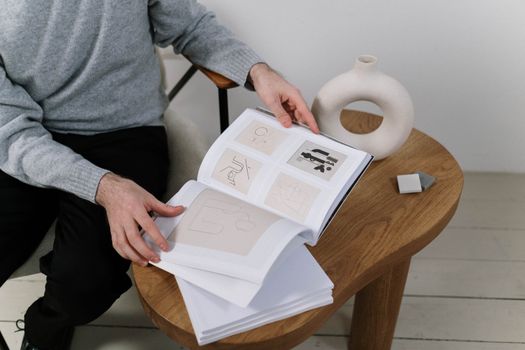
A man flips through pages of a design portfolio on a wooden table in modern style. Photo: cottonbro studio / Pexels
Beyond showcasing visually appealing designs, one of the most impactful graphic design portfolio tips is to transform your projects into compelling case studies. A beautiful image is a great hook, but a well-told story behind that image is what truly engages and convinces potential employers or clients of your value. Case studies demonstrate your thought process, problem-solving abilities, and how you translate challenges into effective visual solutions. They allow your audience to understand not just *what* you designed, but *why* you designed it, and what impact it had. Each case study should follow a clear narrative arc, typically encompassing these key elements: 1. **The Challenge/Problem:** Begin by clearly outlining the client's problem, the project's objectives, or the specific design brief you were addressing. What was the core issue that needed solving? This sets the stage and provides context for your work. 2. **Your Role & Process:** Describe your specific involvement in the project. Were you the sole designer, part of a team, or a creative lead? Detail your design process. This could include research, brainstorming, sketching, wireframing, mood boarding, user testing, iteration, and collaboration. Showing your process is crucial; it reveals your strategic thinking and how you approach design systematically. Don't just show the final product; show the journey. This is where you differentiate yourself from designers who only present polished deliverables. 3. **The Solution:** Present your final design solution(s) clearly and attractively. This is where your high-fidelity mockups, finished illustrations, or implemented UI designs come into play. Show the work in context – how it would look in the real world (e.g., a logo on a business card, a website on a phone, a poster in an environment). Use high-quality images and thoughtful presentation. 4. **The Impact/Results:** This is arguably the most critical part. Quantify the success of your design whenever possible. Did the new website increase conversions by X%? Did the branding campaign lead to a Y% increase in brand recognition? Did user testing reveal improved usability? Even if hard data isn't available, discuss the qualitative impact – how the design met the objectives, improved communication, or resonated with the target audience. This section transforms your design from an aesthetic exercise into a valuable business asset. Use clear, concise language, avoiding jargon where possible. Break up text with visuals, such as process sketches, mood boards, or before-and-after comparisons. The goal is to make it easy for the viewer to follow your journey and understand your contribution. A strong case study not only showcases your technical skills but also highlights your strategic thinking, communication abilities, and understanding of business objectives, making your portfolio a much more persuasive tool. For further reading on crafting compelling narratives, consider exploring articles on effective communication for designers. This storytelling approach is what elevates your portfolio from good to outstanding, leaving a memorable impression.

Common Portfolio Mistakes to Avoid and Best Practices to Adopt

Top view of a woman reviewing various documents with a clipboard on a desk. Photo: Monstera Production / Pexels
Even with the best intentions, designers often make common mistakes that can hinder their portfolio's effectiveness. Avoiding these pitfalls and adopting proven best practices can significantly boost your chances of success. **Common Mistakes to Avoid:** * **Including everything you've ever made:** As discussed, quality over quantity is paramount. Resist the urge to showcase every project from college or every small freelance gig. Focus on your strongest work that aligns with your goals. * **Lack of context or process:** Presenting only final designs without explaining the problem, your process, or the outcome is a huge missed opportunity. Your audience wants to see how you think. * **Poor presentation:** Low-resolution images, inconsistent formatting, broken links, or a clunky user experience on your portfolio site can instantly turn off viewers. Attention to detail in your portfolio reflects your attention to detail in your design work. * **No contact information:** Make it incredibly easy for people to reach you. Include your email, LinkedIn profile, and any other relevant professional links prominently. * **Forgetting to proofread:** Typos, grammatical errors, and awkward phrasing undermine your professionalism. Always proofread your text carefully, or better yet, have someone else review it. * **Generic portfolio:** If your portfolio looks like everyone else's, it won't stand out. Inject your personality and unique perspective where appropriate, while maintaining professionalism. **Best Practices to Adopt:** * **Keep it updated:** Your portfolio should be a living document. Regularly add new, strong work and remove older, less relevant pieces. Aim to review and update it at least quarterly. * **Tailor for specific opportunities:** While you'll have a core portfolio, be prepared to customize it for different job applications or client pitches. Highlight projects most relevant to the role or industry you're targeting. * **Get feedback:** Ask trusted mentors, peers, or even potential employers for honest critiques of your portfolio. Fresh eyes can spot areas for improvement you might have overlooked. * **Showcase variety (strategically):** While focusing on your niche, demonstrate a reasonable range of skills within that niche. For example, a UI/UX designer might show mobile, web, and app designs. A brand designer might show logos, packaging, and brand guidelines. * **Consider a personal brand:** Your portfolio itself is an extension of your personal brand. Ensure its aesthetic, tone, and user experience align with the professional image you want to project. * **Optimize for mobile:** Many recruiters view portfolios on tablets or phones. Ensure your website is fully responsive and looks great on all devices. By consciously avoiding these common errors and diligently applying these best practices, your graphic design portfolio will not only present your work effectively but also convey your professionalism, thoughtfulness, and dedication to your craft, significantly increasing its impact.

Comparison

FeaturePersonal WebsiteBehance/DribbblePDF PortfolioInstagram
Control/CustomizationHighMediumHighLow
Exposure/CommunityLow (needs promotion)HighLow (direct share)Medium (visual focus)
Case Study DepthHighMediumHighLow
SEO PotentialHighLowNoneLow
CostMedium-HighFree-LowFreeFree

What Readers Say

"These graphic design portfolio tips completely transformed my approach. I landed my dream job at a top agency after implementing the case study advice and curating my work. It's truly a game-changer!"

Sarah J. · New York, NY

"I was struggling to get interviews, but after applying the 'quality over quantity' principle from these tips, I saw an immediate difference. My portfolio now feels professional and impactful."

David L. · Los Angeles, CA

"The advice on storytelling through projects was invaluable. I redesigned my portfolio, focusing on the 'why' behind each piece, and secured three new freelance clients within a month. Incredible results!"

Emily R. · Chicago, IL

"While most tips were fantastic, I found the personal branding section could have been a bit more detailed. Still, the core advice on curation and case studies drastically improved my portfolio's appeal."

Mark T. · Austin, TX

"As a recent graduate, I felt overwhelmed by portfolio building. These graphic design portfolio tips provided a clear, actionable roadmap. I now feel confident showcasing my work to potential employers."

Jessica M. · Seattle, WA

Frequently Asked Questions

What is the most critical element of a graphic design portfolio?

The most critical element is demonstrating your problem-solving process, not just the final outcome. Potential employers and clients want to see how you think, how you approach design challenges, and how you arrive at effective solutions. This is best achieved through well-structured case studies that outline the problem, your process, and the measurable impact of your design.

Should I include school projects in my professional portfolio?

Yes, absolutely, especially if you are a recent graduate or early-career designer. If school projects are strong, demonstrate relevant skills, and align with the type of work you aspire to do, they are perfectly acceptable. Treat them with the same professionalism as client work, crafting thorough case studies for each.

How many projects should I include in my graphic design portfolio?

Aim for a highly curated selection of 5-7 of your absolute strongest projects. The emphasis should always be on quality over quantity. Too many projects can dilute the impact of your best work and overwhelm the viewer. Focus on showcasing your best, most relevant pieces that tell a compelling story.

Is it worth paying for a premium portfolio website builder?

Investing in a premium portfolio website builder can be highly worthwhile if it offers the customization, features, and professional appearance you need. While free platforms are a good starting point, a custom website allows for greater control over branding, SEO, and the overall user experience, which can be crucial for standing out in a competitive market. Consider your budget and the level of control you desire.

How do I make my portfolio stand out from other designers?

To stand out, focus on three key areas: a strong personal brand reflected in your portfolio's aesthetic, unique and compelling case studies that highlight your specific problem-solving approach, and a clear niche or specialization that shows you understand a particular market need. Don't just show 'good design'; show 'your good design' with a purpose.

Who should use graphic design portfolio tips?

Anyone involved in the visual arts and design field, from aspiring students and recent graduates to seasoned professionals looking to refresh their brand or pivot their career, should utilize these graphic design portfolio tips. Freelancers seeking new clients and designers aiming for in-house positions will all benefit from a strategically built and well-presented portfolio.

Is it risky to only show personal projects in a portfolio?

While personal projects can showcase passion and initiative, relying solely on them can be risky if you're seeking client-facing or corporate roles. Employers often look for experience working with real-world constraints, client feedback, and deadlines. A balanced portfolio that includes both strong personal work and client projects (even if pro bono or conceptual for practice) is generally ideal.

What are the future trends for graphic design portfolios?

Future trends emphasize interactivity, personalized experiences, and a deeper integration of storytelling with analytics. Expect more portfolios to incorporate motion graphics, video case studies, and even augmented reality elements. Data-driven results and a clear demonstration of business impact will become even more crucial, moving beyond purely aesthetic presentations to show tangible value.

Armed with these comprehensive graphic design portfolio tips, you're now ready to craft a portfolio that not only showcases your incredible talent but also strategically positions you for success. Start refining your work, telling your story, and confidently pursuing your next big opportunity today. Your dream career is within reach!

Topics: graphic design portfolio tipsdesign portfolio strategiesbuild design portfoliocreative portfolio adviceshowcase design work
Leo List
Brampton weed
Adultwork EstrelaBet Vai de Bet R7 Bet Betão Galera Bet Rainbet Bet9ja Shop SportyBet BetKing Sisal Loto Foot Hollywoodbets YesPlay Odibets RushBet Jugabet BetWarrior BetCity MSport betPawa Fortebet